The best SimilarWeb alternatives in 2026 combine traffic data, keyword research, backlink analysis, and SEO workflows at a lower cost or with stronger accuracy.
SimilarWeb gives you traffic estimates and competitor insights, but it leaves gaps in real workflows. Pricing starts at $199 per month, deeper features require annual contracts, and data becomes less reliable on smaller sites.
That creates a common problem. You get high-level traffic data, but still need other tools for keywords, backlinks, and optimization. Costs increase, and workflows become fragmented.
Modern SimilarWeb competitors solve this differently. Some focus on deeper SEO data, while others combine traffic insights with execution so you can act on the data inside the same platform.
This guide breaks down the 10 best SimilarWeb alternatives with pricing updated for May 2026, tested performance based on real usage, and a clear view of which tool fits each use case.
Why Look for a SimilarWeb Alternative?
Users look for a SimilarWeb alternative because the price runs high, SEO depth stays limited, and smaller sites receive unreliable data. Our tests across 2026 tools show that most teams need more than traffic estimates, focusing on platforms that combine data with execution.
There are 4 main reasons people switch from SimilarWeb, based on real usage patterns:
- High cost limits adoption: Pricing targets enterprise budgets, which creates friction for startups, freelancers, and smaller teams looking for scalable tools.
- Accuracy drops on smaller or niche websites: Data remains strong for large domains, but becomes unreliable below 50,000 monthly visits, especially in niche markets.
- Limited SEO depth reduces practical value: The platform emphasizes traffic trends instead of technical SEO, backlink analysis, and keyword tracking needed for execution.
- The keyword database lacks long-tail coverage: Coverage stays narrower than SEO-focused platforms, which reduces visibility into intent-driven and long-tail opportunities.
What Does SimilarWeb Do Well?
SimilarWeb performs well in competitive traffic analysis and market benchmarking. The platform delivers strong value at a high level, especially for large-scale analysis.
Traffic estimation works best on domains with significant volume, where patterns become easier to model. Audience overlap analysis reveals how users move across competing websites, which clarifies positioning inside a market. Web and app performance data appear in a single view, which strengthens broader competitive analysis.
These strengths come from a multi-source data model that combines ISP partnerships, browser extensions, and direct measurement inputs.
Where Does SimilarWeb Fall Short?
SimilarWeb falls short in SEO execution, keyword depth, and smaller-site accuracy. These limitations become clear once teams move from analysis into implementation.
Keyword research lacks advanced clustering and detailed ranking insights, which reduces its usefulness for SEO strategy. The platform does not include a site auditor, rank tracker, or content optimization system.
Accuracy becomes another issue on smaller websites, where traffic estimates often differ significantly from Google Analytics data. This gap creates uncertainty in competitive analysis for niche markets.
Content-level insights remain limited, since analysis focuses on domains instead of individual pages. Teams that rely on content performance data often require separate tools to fill that gap.
Who Should Skip SimilarWeb Entirely?
Solo SEOs, SMB teams, content agencies, and anyone with a budget under $200 per month should skip SimilarWeb entirely. The platform targets enterprise buyers, not execution-focused teams with limited budgets.
SimilarWeb delivers value in large-scale market intelligence, but smaller teams rarely use that level of data. Pricing and feature access create a gap between what smaller teams need and what the platform provides.
There are 4 main groups that should avoid SimilarWeb, based on cost, accuracy, and workflow limitations:
- Solo SEOs and freelancers face cost constraints. The $199 per month Starter plan only unlocks basic traffic data. Advanced features sit behind annual contracts that range from $14,000 to $35,000, which makes the platform impractical at this level.
- SMB marketing teams struggle with limited ROI. Smaller teams focus on execution, not high-level market benchmarking. SimilarWeb emphasizes traffic analysis instead of actions that improve rankings, content, or campaigns.
- Content agencies need deeper page-level and SEO insights. The platform does not provide content auditing, keyword tracking, or optimization workflows. Agencies that manage multiple clients require tools that move from insight to execution.
- Local businesses and niche site owners face data accuracy issues. Websites with fewer than 5,000 to 10,000 monthly visits often receive incomplete or unreliable estimates. These gaps make competitive analysis difficult and inconsistent.
The mismatch happens because SimilarWeb focuses on market intelligence, not operational SEO or marketing execution. Teams that need technical audits, content optimization, or campaign management will not find those workflows inside the platform.
What Does SimilarWeb Cost in 2026 and What Do You Actually Get?
SimilarWeb pricing costs $199 per month for Starter, $14,000 per year for Team, $35,000 per year for Business, and $16,000 to $200,000 per year for Enterprise. SimilarWeb subscription cost increases quickly once teams move beyond basic traffic data.
Monthly billing only exists on the Starter plan, while every higher tier requires an annual contract. Listed prices represent entry points, not final negotiated costs.
Each plan expands access to data, seats, and advanced features, but core functionality remains focused on traffic analysis.
- Starter plan: Includes 3 months of historical data, 5 results per metric, and a single user seat. This tier focuses on basic traffic insights without deeper segmentation.
- Team plan: Increases access to 15 months of historical data, removes result limits, and supports 5 user seats. This tier introduces broader competitive analysis but still centers on traffic-level insights.
- Business plan: Adds API access, advanced segmentation, and 10 user seats. This tier targets larger organizations that require deeper data extraction and integrations.
- Enterprise contracts: Bundle additional modules, custom data refresh rates, and dedicated account management. These agreements vary significantly based on scope and negotiation.
Conversion Analysis, Market Research, and AI Traffic modules sit outside base plans as paid add-ons, which increases total cost beyond the listed tiers.
Why Does SimilarWeb Monthly Billing Cost More Than Annual?
The SimilarWeb Monthly billing costs 20% to 25% more because flexibility carries a pricing premium. Annual contracts lock in lower rates, while monthly plans reflect shorter commitments.
Starter pricing drops to around $125 per month on annual billing, compared to $149 to $199 on monthly billing. Buyers comparing tools need to normalize pricing across annual and monthly structures to understand real cost differences.
What Hidden Costs Come With SimilarWeb?
SimilarWeb has hidden costs that come from add-ons, seat expansion, API usage, and annual commitments. These costs increase total spend beyond the base subscription.
Conversion Analysis alone adds roughly $5,000 to $15,000 per year. Additional user seats increase costs further once teams exceed the included limits. API access introduces usage-based pricing, which scales with data consumption.
Annual contracts tie budget allocation for 12 months, which reduces flexibility compared to monthly tools.
Is SimilarWeb Worth the Price in 2026?
SimilarWeb is worth the price only for enterprise teams that require large-scale traffic intelligence and have budgets above $14,000 per year. Value aligns with organizations that rely on market-level data for strategic decisions.
The platform delivers strong traffic estimation through panel and ISP data, which performs well on high-traffic domains. Enterprise teams running competitive intelligence, media planning, or acquisition research benefit from this level of data.
Smaller teams and execution-focused marketers rarely extract full value. High pricing, add-on costs, and limited execution features create a gap between cost and practical use.
What Are the Similarweb Alternatives?
The best SimilarWeb alternatives are platforms that combine traffic data with SEO, content, and execution workflows at lower cost levels. These tools cover keyword research, competitor analysis, and campaign performance with stronger practical use.
The list below ranks 10 tested SimilarWeb alternatives based on pricing and real-world use cases in 2026.
| # | Tool | Best for | Entry price (monthly) | Top-tier price | Free trial |
| 1 | Search Atlas | Full SEO + Marketing + AI Agentic execution | $99 | $999 (Agency) | 7-day, full access |
| 2 | BuiltWith | Tech-stack intelligence | $295 (Basic) | $995 (Team) | None |
| 3 | Ubersuggest | Solo founders, SMBs | $29 (Individual) | $99 (Enterprise) | 7-day |
| 4 | SE Ranking | Mid-market all-in-one | $65 (Essential) | $259 (Business) | 14-day |
| 5 | Serpstat | Budget SEO suite | $69 (Individual) | $499 (Agency) | 7-day |
| 6 | Ahrefs | Backlink depth + Site Explorer | $129 (Lite) | $1,499 (Enterprise) | None |
| 7 | SpyFu | Competitor PPC research | $33 (Basic) | $249 (Team) | 30-day refund |
| 8 | Moz Pro | Brand authority basics | $49 (Starter) | $299 (Large) | 7-day |
| 9 | AccuRanker | Dedicated rank tracking | $224 (Professional) | $2,409 (Enterprise) | Yes, on request |
| 10 | Semrush | Enterprise traffic + keyword data | $139.95 (Pro) | $499.95 (Business) | 7-day |
What Are the Best SimilarWeb Alternatives in 2026?
The best alternatives to SimilarWeb in 2026 are listed below.
1. Search Atlas
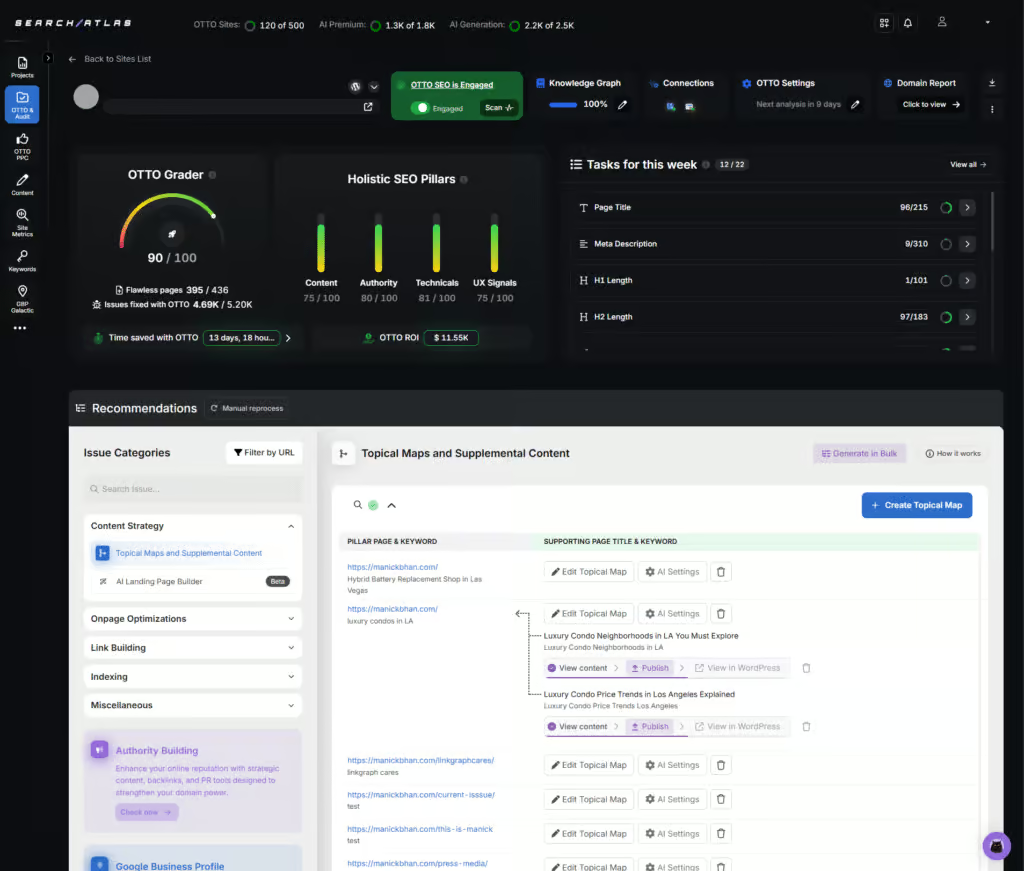
Search Atlas is an AI-powered, all-in-one digital agentic marketing platform that combines competitor traffic intelligence, keyword research, backlink analysis, and automated execution through the OTTO SEO engine and Atlas Agent inside one workspace.
Search Atlas centralizes the 4 data jobs a SimilarWeb buyer runs. Traffic estimates, keyword research, backlink analysis, and reporting sit in one system. The difference comes from execution. Atlas Agent and OTTO SEO apply changes directly instead of stopping at insights.
Search Atlas stands as the best SimilarWeb alternative because it integrates SEO, GEO, AEO, and AI search visibility into one workflow, applies agentic AI to execute work automatically, delivers strong value for the price, and continues to evolve with new execution-focused features.
How does Search Atlas Site Explorer compare to SimilarWeb?
Search Atlas Site Explorer measures domain-level, subdomain-level, and URL-level performance across organic, paid, and backlink datasets, while SimilarWeb measures only traffic and audience behavior at the domain level.
Site Explorer organizes metrics around four Holistic SEO pillars. Each pillar surfaces actionable signals tied to the proprietary Domain Power metric, a 100-point logarithmic authority benchmark calibrated against SERP performance rather than link count alone.
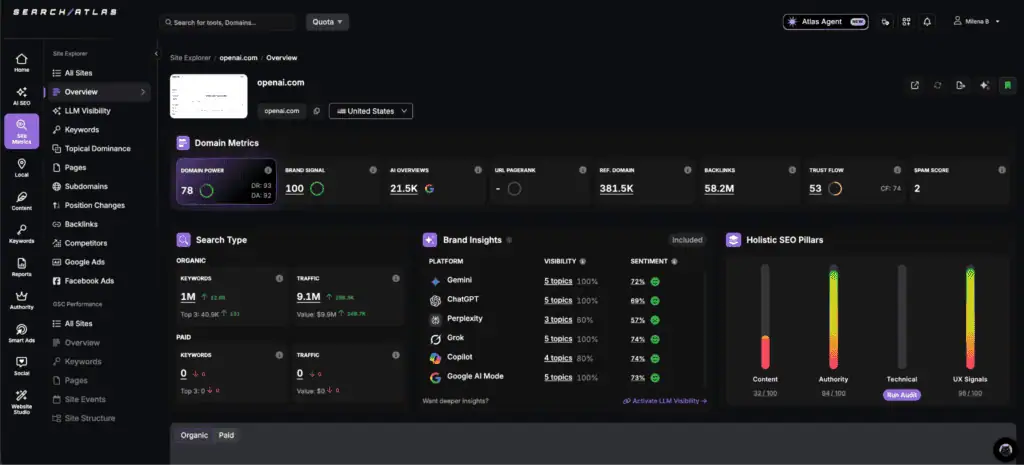
Site Explorer shows organic keyword positions, paid keyword bids, backlink quality with Trust Flow and Spam Score, Keyword Gap Analysis, Backlink Gap Analysis, Topical Dominance scoring, and LLM Visibility tracking, none of which appear in SimilarWeb.
The platform uses real-time SERP synchronization, so ranking changes appear the same day search results update. SimilarWeb refreshes its traffic panel monthly and does not publish keyword position data.
What does Search Atlas cost in 2026?
Search Atlas costs $99 per month on the Starter plan, $199 per month on Growth, $399 per month on Pro, $999 per month for Agency, and custom pricing on Enterprise. Every plan includes a 7-day free trial with full feature access and no credit card required.
The Starter plan includes 1 OTTO SEO project, 2,000 tracked keywords, 5 GSC site projects, and 2 user seats. The Pro plan opens 4 OTTO projects, 6,000 tracked keywords, unlimited GSC integrations, and full white-label dashboards.
Who is Search Atlas best for?
Search Atlas is best for agencies managing multi-client SEO portfolios, in-house marketers replacing fragmented tool stacks, e-commerce, and brands consolidating SEO, GEO, and AEO operations into one workflow.
What are the pros and cons of Search Atlas?
Search Atlas Pros include time-saving automation, unified SEO and marketing workflows, agentic execution through Atlas Agentic, and built-in AI systems that apply changes directly.
The main limitation comes from the learning curve. The platform covers multiple workflows, and onboarding is available to guide how each system connects.
2. BuiltWith
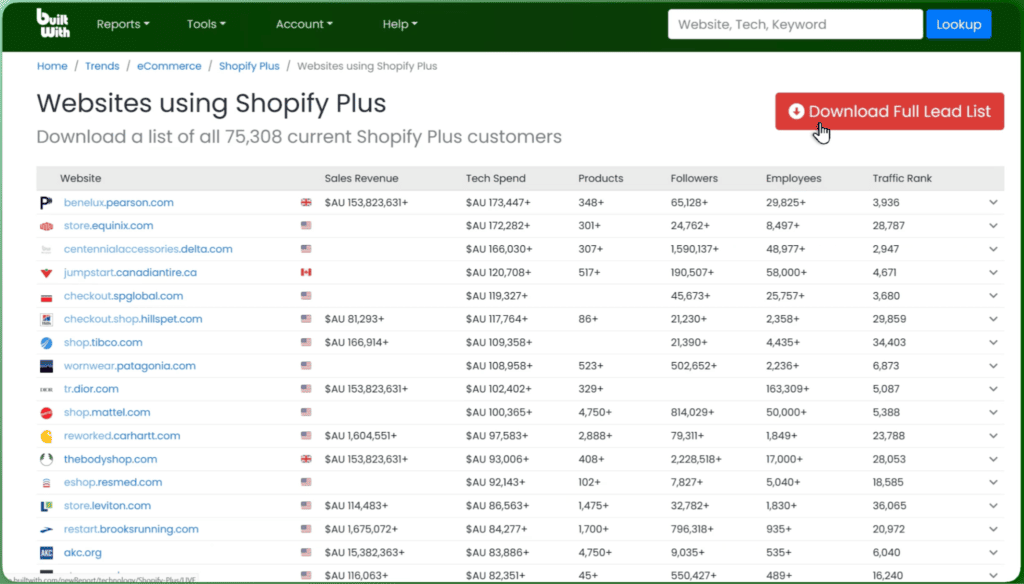
BuiltWith is a technology intelligence platform that identifies the CMS, analytics tools, ad networks, and SaaS products running on any website. Based on hands-on testing, BuiltWith stands out as a SimilarWeb alternative because it focuses on tech-stack data instead of traffic analysis.
BuiltWith platform scans domains and returns detected technologies across hosting, tracking, advertising, and infrastructure layers. This makes it useful for prospecting and competitive research rather than SEO or traffic benchmarking.
How does BuiltWith compare to SimilarWeb?
BuiltWith identifies what technologies a competitor uses, while SimilarWeb measures how much traffic that competitor receives. The platforms cover different parts of competitive intelligence.
During testing, BuiltWith consistently returned clear technology stacks for most mid-to-large websites. SimilarWeb, in contrast, focused on traffic sources, audience behavior, and visit estimates. The overlap between the two tools remains minimal.
BuiltWith answers “what is this site built on?” SimilarWeb answers “how much traffic does this site get?” Teams that require both perspectives often run the tools together.
What does BuiltWith cost in 2026?
BuiltWith costs $295 per month for Basic, $495 per month for Pro, and $995 per month for Team, which requires annual billing. Pricing increases based on tracking depth and export capabilities.
Basic plan limits tracking to 2 technologies, while Pro expands to 10. The Team plan removes limits and unlocks full dataset access. No free trial exists, which makes evaluation harder compared to other tools.
Who is BuiltWith best for?
BuiltWith is best for B2B sales teams, market researchers, and product teams that need technology-level insights.
In practical use, sales teams rely on BuiltWith to identify companies using competitor tools, then build outbound lists. Market researchers track adoption trends across industries. Product teams analyze how competitors structure their tech stacks.
BuiltWith does not replace SimilarWeb for traffic intelligence or SEO platforms for keyword research. It works as a complementary dataset rather than a standalone solution.
What are the pros and cons of BuiltWith?
Pros come from its database scale. BuiltWith tracks technology usage across more than 250 million websites, which makes it effective for lead generation and competitive mapping. Cons come from pricing and detection accuracy. The entry cost sits high compared to most SEO tools, and some detected technologies appear outdated or incomplete during testing.
3. Ubersuggest
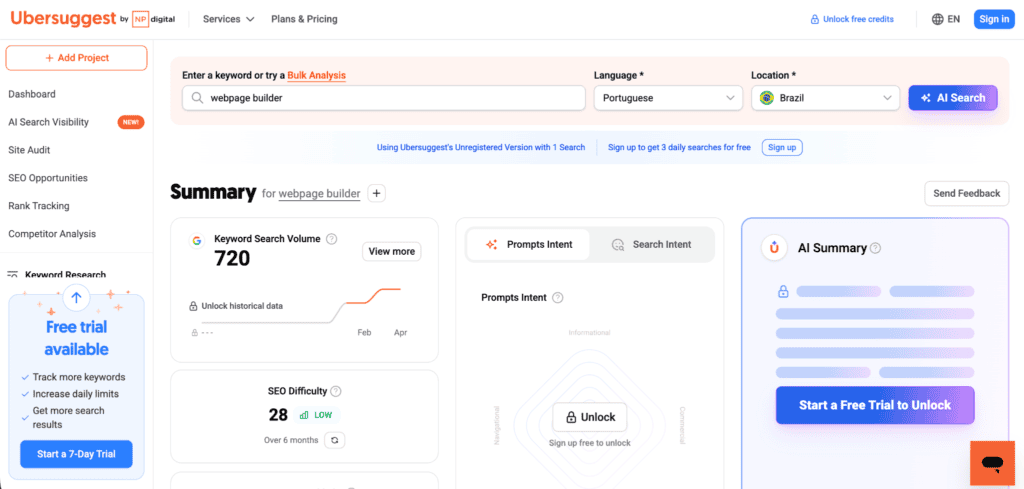
Ubersuggest is a keyword research and entry-level SEO tool that surfaces keyword ideas, search volume, and basic competitor data at a low monthly cost. Based on hands-on testing, Ubersuggest works best as a starter tool, not a full SimilarWeb replacement.
Ubersuggest targets beginners. The platform simplifies SEO workflows and pairs with educational content, which makes onboarding easier for non-specialists.
How does Ubersuggest compare to SimilarWeb?
Ubersuggest focuses on keyword research, site audits, and basic SEO tracking, while SimilarWeb focuses on traffic intelligence, audience data, and market benchmarking.
In testing, Ubersuggest delivered keyword ideas, search volume, content suggestions, rank tracking, and basic backlink data inside a simple interface. These features make it useful for identifying opportunities and tracking SEO performance.
SimilarWeb, in contrast, provided traffic estimates, channel breakdowns, audience demographics, and competitor benchmarking. These features focus on market-level analysis rather than execution.
What does Ubersuggest cost in 2026?
Ubersuggest costs $29 per month for Individual, $49 per month for Business, and $99 per month for Enterprise, with optional lifetime plans. Testing shows the Individual plan supports one project with basic tracking. The Enterprise plan expands to 25 projects and higher keyword limits. A 7-day free trial exists for monthly plans only.
Who is Ubersuggest best for?
Ubersuggest is best for solo founders, bloggers, and small businesses that need simple SEO insights at the lowest cost. In real use, it works well for early-stage projects. Keyword suggestions, basic audits, and rank tracking provide enough direction to get started.
Teams focused on scaling organic growth usually outgrow the platform within 6 to 12 months due to limited data depth.
What are the pros and cons of Ubersuggest?
Ubersuggest’s pros come from pricing and ease of use. The interface stays simple, and the tool provides enough data for beginners. Cons come from smaller datasets and lower accuracy. Keyword data, backlinks, and traffic estimates lack the depth found in platforms like Search Atlas.
4. SE Ranking
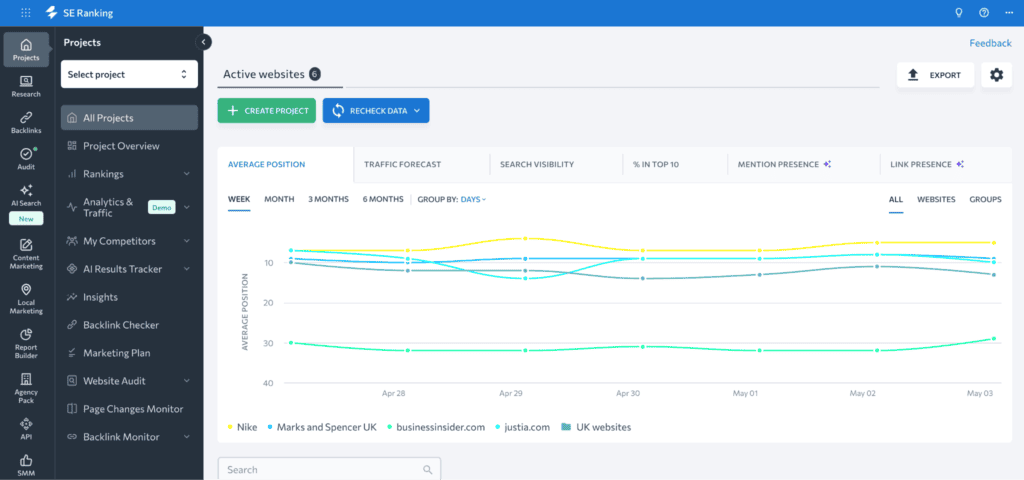
SE Ranking is an all-in-one SEO platform that includes rank tracking, site audits, backlink monitoring, and keyword research at mid-market pricing. SE Ranking delivers strong value for teams that need a complete SEO toolkit without enterprise costs.
How does SE Ranking compare to SimilarWeb?
SE Ranking includes rank tracking, keyword research, backlink monitoring, and site audits, while SimilarWeb focuses on traffic intelligence, audience data, and market benchmarking.
SE Ranking includes features like keyword tracking, site audits, and backlink monitoring. SimilarWeb includes traffic data, channel breakdowns, and audience behavior.
In our testing, SE Ranking delivered consistent rank tracking, keyword position updates, site audit reports, and backlink monitoring inside one interface. These features support ongoing SEO execution and performance tracking.
SimilarWeb, in contrast, provided traffic estimates, traffic sources, and audience insights without tools for ranking improvements or technical optimization.
The difference becomes clear in use. SE Ranking supports SEO execution and performance tracking, while SimilarWeb supports high-level traffic analysis for competitive research.
What does SE Ranking cost in 2026?
SE Ranking costs $65 per month for Essential, $119 per month for Pro, and $259 per month for Business, with discounts on annual billing.
Essential plan tracks 500 keywords across 5 projects. The Business plan expands to 5,000 keywords, API access, and multiple user seats. A 14-day free trial is available.
Who is SE Ranking best for?
SE Ranking is best for small agencies, freelancers, and in-house teams managing multiple websites. In practice, it works well for teams running 5 to 30 sites that need rank tracking, audits, and reporting in one place. White-label reporting supports client workflows.
Teams that require AI execution, content generation, or AI search tracking often outgrow SE Ranking and move to platforms like Search Atlas.
What are the pros and cons of SE Ranking?
SE Ranking pros come from value. The platform provides rank tracking, audits, and reporting at a lower price than enterprise tools. SE Ranking cons come from smaller keyword and backlink databases. Scaling campaigns across large datasets requires more advanced platforms.
5. Serpstat
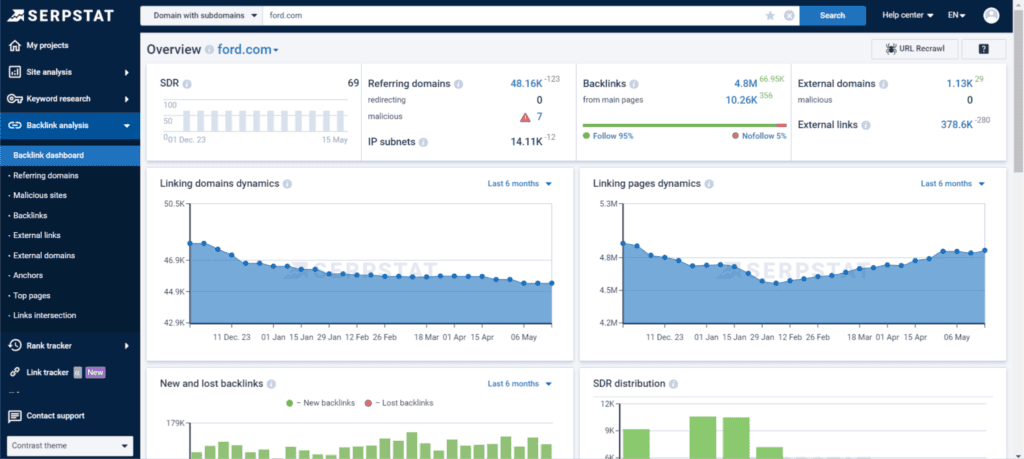
Serpstat is an all-in-one SEO platform that combines keyword research, rank tracking, site audits, backlink analysis, and competitive research at a lower price point. Serpstat delivers strong coverage for teams that need broad SEO functionality without enterprise pricing.
How does Serpstat compare to SimilarWeb?
Serpstat focuses on keyword data, SERP analysis, and SEO workflows, while SimilarWeb focuses on traffic estimates and audience behavior. Serpstat includes keyword clustering, rank tracking, and site audits. SimilarWeb includes traffic sources, demographics, and competitor traffic benchmarks.
During testing, Serpstat performed well for keyword discovery, rank tracking, and audit reporting. The platform provided enough depth to support ongoing SEO work, especially for smaller sites. SimilarWeb, in contrast, provided stronger traffic modeling but lacked keyword-level insights and technical SEO tools.
The difference shows in usage. Serpstat supports building and optimizing SEO campaigns. SimilarWeb supports understanding market traffic patterns.
What does Serpstat cost in 2026?
Serpstat costs $69 per month for Individual, $129 per month for Team, and $499 per month for Agency. A 7-day free trial is available on Individual and Team plans.
The Individual plan fits a single user. The Team plan adds API access and collaboration. The Agency plan unlocks white-label reporting and higher limits.
Who is Serpstat best for?
Serpstat is best for solo SEOs, small agencies, and teams working with multilingual or regional SEO data. It fits users who want solid functionality at a lower cost. Larger teams or advanced workflows often move to platforms like Search Atlas after scaling beyond basic needs.
What are the pros and cons of Serpstat?
Serpstat pros come from pricing and feature coverage. The platform delivers keyword research, audits, and competitive analysis in one place. Serpstat cons come from limited backlink depth and slower performance on larger datasets. It works better for small to mid-sized projects than enterprise-scale campaigns.
6. Ahrefs
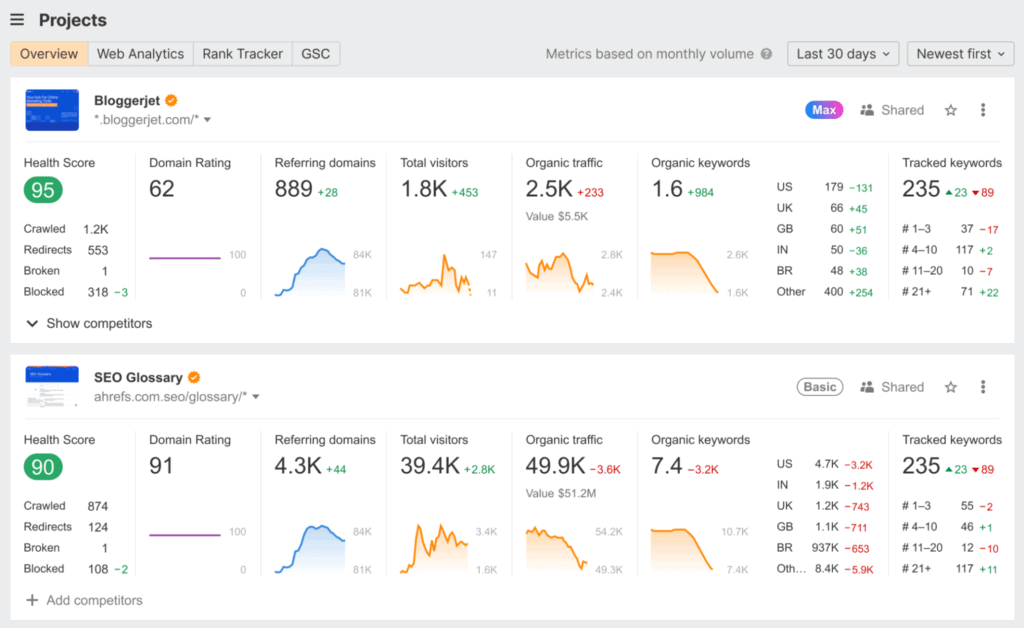
Ahrefs is an SEO platform that combines a massive backlink index with keyword research, rank tracking, and site auditing in one interface. Ahrefs delivers strong value for teams that need deep SEO data, especially around backlinks and organic search performance.
Ahrefs runs one of the largest independent web crawlers outside of Google. This infrastructure gives it a strong reputation for backlink accuracy and competitive analysis across industries.
How does Ahrefs compare to SimilarWeb?
Ahrefs connects traffic estimates with keywords, backlinks, and SERP data, while SimilarWeb focuses only on traffic and audience-level insights.
Ahrefs includes features like Site Explorer, Keywords Explorer, backlink analysis, rank tracking, and content research. SimilarWeb includes traffic estimates, traffic sources, audience demographics, and competitor benchmarking.
In our testing, Ahrefs provided detailed keyword rankings, search volume, keyword difficulty, and SERP position data tied directly to traffic. This makes Ahrefs the stronger tool in a SimilarWeb vs Ahrefs keywords comparison, because it shows exactly which queries drive competitor traffic and how rankings are built.
SimilarWeb, in contrast, showed traffic estimates and channel breakdowns but did not connect that data to keywords, backlinks, or ranking positions.
What does Ahrefs cost in 2026?
Ahrefs costs $129 per month for Lite, $249 per month for Standard, $449 per month for Advanced, and $1,499 per month for Enterprise. A limited Starter plan at $29 per month provides restricted access to core tools.
Annual billing reduces pricing across all plans. Ahrefs does not offer a free trial.
The Lite plan supports small projects with basic limits. The Standard and Advanced plans increase keyword tracking, backlink analysis limits, and reporting capabilities. Enterprise unlocks higher limits and advanced access for large teams.
Who is Ahrefs best for?
Ahrefs is best for technical SEOs, link builders, and content teams focused on competitive analysis and organic growth. It works well for teams that need detailed backlink data and keyword-level insights to guide strategy.
In practice, Ahrefs fits workflows centered on research and planning. Teams analyzing competitors, building links, or reverse-engineering rankings rely on its data depth.
Teams that need execution, automation, or integrated content workflows often combine Ahrefs with Search Atlas or migrate to a platform that includes those capabilities.
What are the pros and cons of Ahrefs?
Ahrefs’ pros come from data depth and reliability. The platform provides one of the largest backlink databases, accurate keyword research, and strong competitor analysis tools.
Ahrefs’ cons come from pricing and usability at scale. Plans become expensive as usage increases, and lower tiers limit reports, exports, and tracked data. The platform focuses on analysis, which means execution requires additional tools.
7. SpyFu
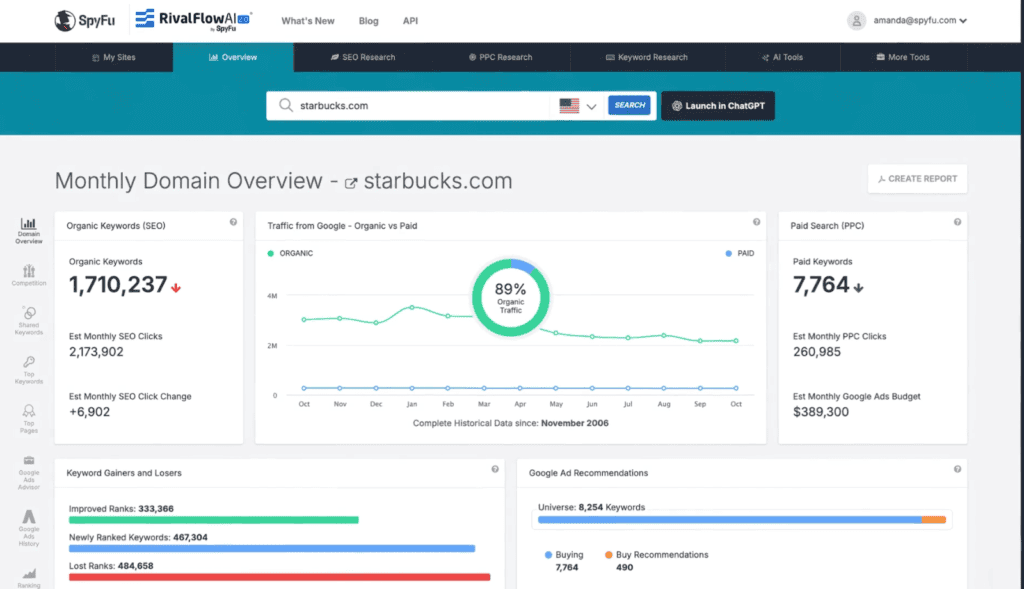
SpyFu is a competitor research tool focused on PPC keyword history, ad copy archives, and SEO keyword overlap, built on more than a decade of advertising data. SpyFu delivers strong value for teams that want visibility into competitor ad strategies at a low cost.
SpyFu tracks which keywords competitors bid on and what ad copy they run over time. This makes it useful for PPC research and campaign planning.
How does SpyFu compare to SimilarWeb?
SpyFu focuses on PPC keyword data and ad history, while SimilarWeb focuses on traffic intelligence, audience data, and channel breakdowns.
SpyFu includes features like keyword history, ad copy archives, and the Kombat tool for domain comparison. SimilarWeb includes traffic estimates, traffic sources, and audience insights.
In our testing, SpyFu delivered detailed PPC keyword history and ad variations across multiple competitors. The Kombat feature made it easy to compare keyword overlap between domains.
SimilarWeb, in contrast, showed traffic volume and channel distribution but did not provide visibility into ad copy or bidding strategies.
What does SpyFu cost in 2026?
SpyFu costs $33 per month for Basic, $58 per month for Professional, and $249 per month for Team when billed monthly. Annual billing reduces Basic to around $22 and Professional to around $39 per month.
The Basic plan includes limited searches and no API access. Higher tiers expand usage limits and add team features. A 30-day money-back guarantee is included.
Who is SpyFu best for?
SpyFu is best for PPC managers, agencies pitching new clients, and SEOs who want historical ad copy data alongside keyword research. In practice, it works well for competitor PPC analysis and campaign planning. Most teams use SpyFu alongside SEO platforms rather than as a standalone solution.
What are the pros and cons of SpyFu?
SpyFu’s pros come from PPC data visibility. The platform provides long-term ad history, unlimited search results, and a simple interface. SpyFu cons come from limited international coverage and lower accuracy in some keyword datasets. The platform lacks full SEO audits and deeper technical analysis.
8. Moz Pro
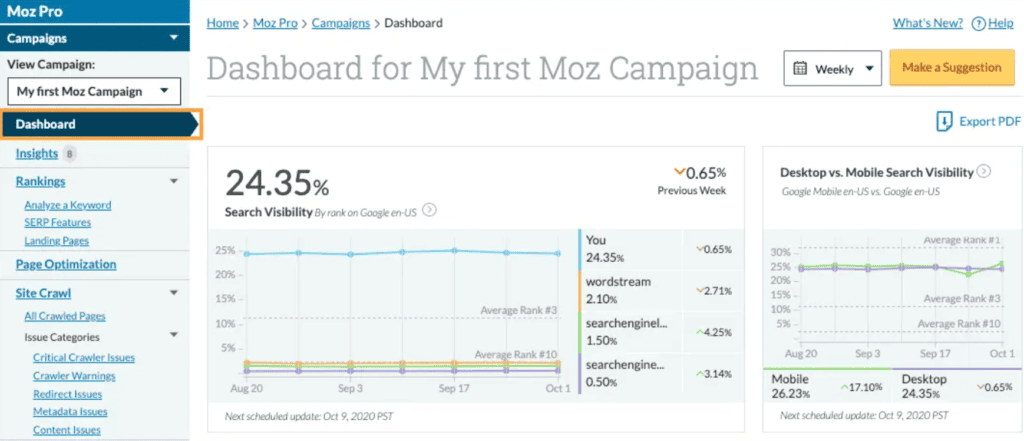
Moz Pro is an SEO platform built around Domain Authority and Page Authority, with tools for keyword research, backlink analysis, site audits, and rank tracking. Moz Pro delivers steady performance for teams that rely on established SEO metrics and workflows.
How does Moz Pro compare to SimilarWeb?
Moz Pro focuses on keyword research, backlink analysis, and rank tracking, while SimilarWeb focuses on traffic intelligence and audience insights.
Moz Pro includes features like Keyword Explorer, Link Explorer, site crawl audits, and rank tracking. SimilarWeb includes traffic estimates, channel breakdowns, and competitor traffic benchmarking.
In our testing, Moz Pro delivered consistent keyword data, backlink analysis, and site audit reports. Domain Authority remained a useful reference point for evaluating site strength.
SimilarWeb, in contrast, provided traffic insights but did not connect that data to keyword rankings or backlink profiles.
What does Moz Pro cost in 2026?
Moz Pro costs $49 per month for Starter, $99 per month for Standard, $179 per month for Medium, and $299 per month for Large when billed monthly. Annual billing reduces pricing by around 20 percent.
The Starter plan includes basic tracking for one user. Higher tiers expand keyword limits, user seats, and reporting capabilities. A 7-day free trial is available.
Who is Moz Pro best for?
Moz Pro is best for SEOs who rely on Domain Authority, content teams using MozBar, and SMB marketers learning SEO through structured workflows. In practice, it works well for teams that prefer a stable and familiar SEO environment. Teams needing deeper datasets or AI-driven workflows often move to platforms like Search Atlas.
What are the pros and cons of Moz Pro?
Moz Pro pros come from usability and established metrics. The platform provides clear reporting, accessible tools, and widely recognized authority scoring. Moz Pro cons come from smaller keyword and backlink databases compared to other tools, along with slower updates and limited AI-driven features.
9. AccuRanker
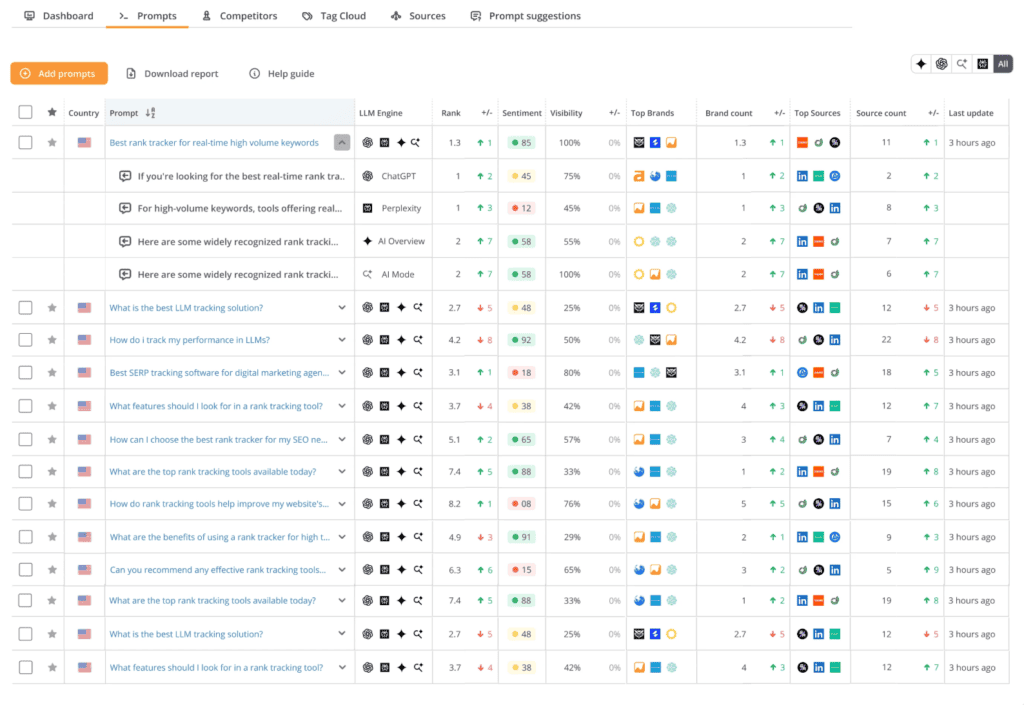
AccuRanker is a dedicated keyword rank tracking platform that focuses on fast, accurate position tracking across large keyword sets. AccuRanker delivers strong performance for teams that need precise ranking data without extra SEO modules.
AccuRanker tracks keyword positions daily and on demand, without including keyword research, site audits, or backlink analysis.
How does AccuRanker compare to SimilarWeb?
AccuRanker focuses on keyword rank tracking, while SimilarWeb focuses on traffic intelligence and audience data. The platforms solve different problems and rarely overlap.
AccuRanker includes features like daily rank updates, on-demand refreshes, and Share of Voice tracking. SimilarWeb includes traffic estimates, channel breakdowns, and audience insights.
In our testing, AccuRanker delivered fast and consistent ranking updates, with the ability to refresh positions instantly during SERP changes. This made it useful for tracking volatility and campaign impact in real time.
SimilarWeb, in contrast, provided traffic insights but did not offer keyword-level ranking data or tracking tools.
What does AccuRanker cost in 2026?
AccuRanker costs $224 per month for Professional (2,000 keywords), $849 per month for Expert (10,000 keywords), and $2,409 per month for Enterprise (40,000 keywords). Annual billing applies a 10% discount.
Pricing scales based on keyword volume rather than features. Higher tiers increase tracking limits and access for larger teams.
Who is AccuRanker best for?
AccuRanker is best for enterprise SEO teams, agencies focused on rank tracking, and teams monitoring large keyword portfolios.
In practice, it works well for teams tracking thousands of keywords across multiple locations and devices. On-demand updates make it useful during algorithm updates or campaign launches.
What are the pros and cons of AccuRanker?
AccuRanker pros come from fast updates, reliable ranking data, and strong reporting features like Share of Voice. AccuRanker’s cons come from high pricing and a limited scope. The platform focuses only on rank tracking and requires additional tools for keyword research, audits, and backlinks.
10. Semrush
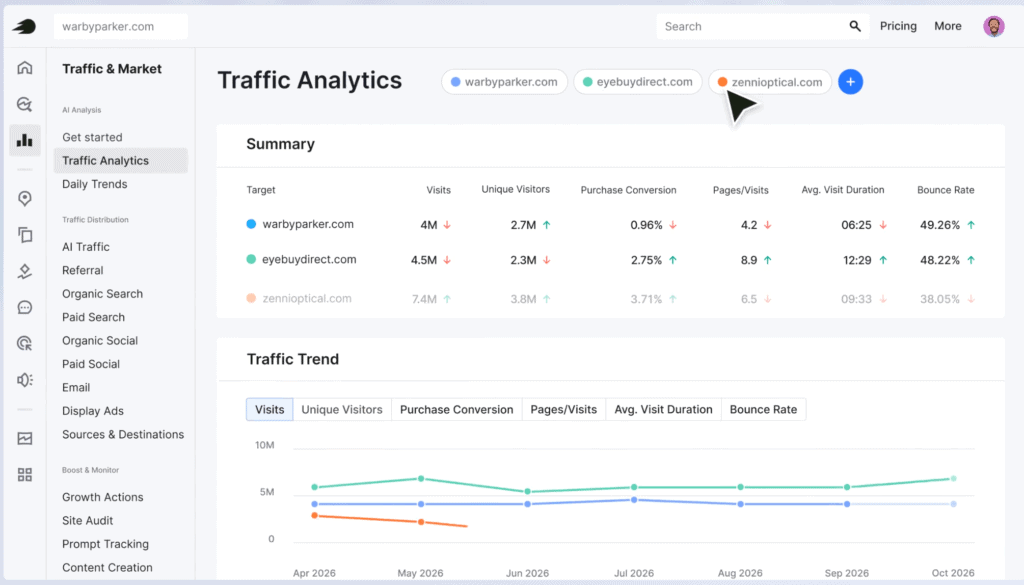
Semrush is an all-in-one SEO and PPC platform that includes keyword research, site audits, backlink analysis, rank tracking, and traffic intelligence. Trends module. Semrush delivers broad functionality for teams that need both SEO and competitive analysis in one platform.
Semrush positions itself as a full marketing suite. The platform, as of 2026, operates under Adobe after its acquisition.
How does Semrush compare to SimilarWeb?
Semrush matches SimilarWeb on traffic intelligence. Trends module and exceeds it in keyword research, backlink data, rank tracking, and on-page SEO tools.
Semrush includes features like Site Audit, Keyword Overview, Backlink Analytics, Position Tracking, and PPC tools. SimilarWeb includes traffic estimates, audience data, and competitor benchmarking.
In our testing, Semrush delivered strong keyword data, backlink insights, and technical audit reports. Trends provided traffic estimates comparable to SimilarWeb for larger domains.
SimilarWeb focused more on traffic modeling and audience insights but lacked execution tools and deeper SEO datasets.
What does Semrush cost in 2026?
Semrush costs $139.95 per month for Pro, $249.95 per month for Guru, and $499.95 per month for Business when billed monthly. Annual billing reduces pricing across all plans.
The Business plan supports up to 40 projects, 5,000 tracked keywords, and large-scale site audits. The. The Trends module sits inside higher tiers or as an add-on. A 7-day free trial is available.
Who is Semrush best for?
Semrush is best for enterprise marketing teams, large agencies, and teams that need both SEO and traffic intelligence in one platform. In practice, it works well for teams managing multiple projects across SEO and PPC workflows. The platform combines research, tracking, and reporting in one system.
What are the pros and cons of Semrush?
The Semrush pros come from its large keyword database, strong competitor insights, and a wide range of tools across SEO and PPC. Semrush cons come from high pricing, a steep learning curve, and additional costs for add-ons like traffic intelligence modules.
How We Tested These SimilarWeb Alternatives
We tested each SimilarWeb alternative against five criteria: traffic accuracy, keyword depth, backlink data, pricing transparency, and feature freshness in 2026. The goal was to measure how each tool performs in real workflows, not just feature lists.
Each platform was tested using the same structure. Traffic estimates were compared against real analytics data when available. Keyword coverage, backlink visibility, and feature usability were evaluated inside each platform using the same queries and workflows.
This approach made it easier to see where SimilarWeb competitors perform well and where gaps appear across different use cases.
Which Tool Has the Most Accurate Traffic Estimates?
Search Atlas, Ahrefs, and Semrush returned the most reliable traffic data across all test domains, which includes smaller sites under 20,000 monthly visits.
In testing, smaller domains created the biggest separation between tools. Search Atlas, Ahrefs, and Semrush continued to return usable estimates, while SimilarWeb, BuiltWith, and AccuRanker often returned limited data or estimates with large error margins.
Accuracy remained consistent on high-traffic domains across most platforms. The difference appeared at the lower end, where many tools rely on thresholds or incomplete datasets.
Which Tool Offers the Best Value for Price?
Search Atlas delivers the strongest value for price. In testing, value came from how much work each platform replaces, not just the monthly price. Search Atlas stood out because it combines traffic data, SEO tools, and execution in one system at $99 to $399 per month.
Semrush and Ahrefs also delivered strong datasets, but the total cost increased once additional features or higher limits were required. SE Ranking and Serpstat offered lower pricing with solid core features, but with reduced data depth.
Which Tool Performs Best for Small vs Large Sites?
Search Atlas performs consistently across small, mid-sized, and large sites, while Ahrefs and Semrush perform strongly on mid-to-large domains and remain usable on smaller ones.
In testing, Search Atlas maintained stable data coverage across all 3 reference domains. Keyword data, traffic estimates, and backlink insights remained available even on sites with under 20,000 visits.
Ahrefs and Semrush performed well on mid-sized and large domains, with strong keyword and backlink datasets. Both tools continued to provide usable data on smaller sites, though depth varied depending on niche and region.
SimilarWeb performed best on large domains with high traffic volumes but struggled with smaller sites due to data thresholds. SE Ranking and Serpstat performed well on small to mid-sized sites but showed limitations on large-scale datasets.
Which SimilarWeb Alternative Is Best in 2026?
Search Atlas ranks as the best SimilarWeb alternative in 2026 because it combines traffic data, keyword research, backlink analysis, and execution in one platform. It replaces analysis-only tools with a system that applies changes directly.
Search Atlas covers the four core jobs that SimilarWeb buyers look for. Traffic estimates, keyword research, backlink analysis, and reporting exist in one workspace. The difference comes from execution. OTTO SEO and Atlas Agent act on the data instead of stopping at insights.
Search Atlas delivers this at $99 per month, while SimilarWeb starts at $199 per month and locks deeper functionality behind annual contracts that begin around $14,000.
Search Atlas stands out because it connects data to action. In testing, most tools split workflows across platforms. Traffic data sits in one tool, keyword research in another, and execution remains manual. Search Atlas removes that friction.
Traffic insights connect directly to keyword opportunities, backlink gaps, and content updates. OTTO SEO deploys technical fixes, schema updates, and content improvements in real time. Atlas Agent translates strategy into executed work across SEO, content, and reporting.
The platform replaces fragmented workflows with a unified system for keyword research, content optimization, competitor benchmarking, and link acquisition. Domain Power measures authority based on real search performance, while systems like Scholar and WILDFIRE extend content evaluation and link acquisition.
Additional features include digital PR automation, local SEO heatmaps, and entity-based content planning that strengthen topical authority and ranking performance.
Search Atlas replaces SimilarWeb and the tools around it. Migrate from SimilarWeb to Search Atlas to replace traffic estimates with actionable SEO execution and automation.
FAQ: SimilarWeb Alternatives
Is SimilarWeb free?
SimilarWeb offers a free version with limited data, but it is not usable for ongoing competitive research. The free plan includes around 5 results per metric, 1 month of historical data, and basic traffic estimates. Active usage requires the $199 per month Starter plan or higher.
Can I get SimilarWeb data without paying for SimilarWeb?
Yes, platforms like Search Atlas include competitor traffic estimates in lower-tier plans.
Which SimilarWeb alternative is best for agencies?
Search Atlas is the best fit for agencies that need execution, reporting, and multi-client management in one platform. The Pro plan at $399 per month includes multiple OTTO projects, thousands of tracked keywords, and white-label dashboards for client reporting.
With Search Atlas, agencies replace multiple tools with one system. Traffic analysis, SEO execution, and reporting happen in the same workflow, which reduces manual work per client.
How accurate are SimilarWeb traffic estimates?
SimilarWeb traffic estimates are reliable for high-traffic domains and less accurate for smaller sites. In testing, accuracy remained stable on sites above 50,000 monthly visits. Below that level, estimates became inconsistent or unavailable due to limited data samples.
What replaced SimilarWeb for SEO teams in 2026?
Platforms like Search Atlas replaced SimilarWeb for most SEO teams in 2026. The shift happened because teams moved from analysis-only tools to platforms that combine traffic data with keyword research, backlinks, and execution.