AI is transforming SEO by changing how search engines interpret language, how content earns visibility, and how optimization workflows operate across traditional and AI-driven search environments. The transformation of SEO explains how artificial intelligence shifts search from keyword matching toward semantic understanding, answer generation, and automated optimization systems. This transformation changes how brands compete for rankings, citations, and authority across modern search platforms.
AI transformation matters because search engines now evaluate meaning, context, entity relationships, and topical completeness instead of relying primarily on keyword frequency and backlinks. Systems powered by large language models (LLMs) analyze semantic relevance, extract passages, and generate conversational answers directly inside search interfaces. This evolution changes how SEO functions in practice because visibility increasingly depends on extractability, factual clarity, and AI citation probability.
AI transformation creates measurable changes across content strategy, technical SEO, and search visibility measurement. AI systems automate site audits, optimize internal linking, classify search intent, and generate answers that reduce reliance on traditional blue link rankings. Search visibility now extends across AI Overviews, conversational interfaces, and generated answers, where citation and semantic authority determine inclusion.
AI transformation requires SEO adaptation through semantic optimization, topical authority building, and AI visibility measurement. SEO strategies that focus only on keyword repetition and isolated rankings lose effectiveness as AI systems prioritize structured explanations, entity clarity, and trustworthy information. Businesses maintaining visibility across AI-driven search environments strengthen long-term performance by optimizing for both traditional rankings and AI-generated answer systems simultaneously.
What Is AI SEO?
AI SEO is the process of optimizing content for both traditional search engines and AI-generated answers across conversational search systems. AI SEO controls how artificial intelligence systems retrieve, interpret, summarize, and cite information in generated responses. AI SEO expands traditional SEO by optimizing content for retrieval, extraction, entity recognition, and citation across AI-powered discovery environments. Brands use AI SEO to increase visibility in AI-generated answers rather than relying solely on blue link rankings.
What systems does AI SEO operate across? AI SEO operates across AI-powered search engines, conversational assistants, and generative answer platforms. These systems retrieve information from multiple sources and generate synthesized responses instead of displaying only ranked pages. AI SEO applies to Google AI Overviews, Google AI Mode, Microsoft Copilot, Perplexity, and OpenAI ChatGPT with browsing because each platform generates answers from retrieved information instead of presenting only links.
What does AI SEO optimize in AI-powered search? AI SEO optimizes how content becomes discoverable, extractable, trustworthy, and reusable by large language models during answer generation. AI SEO focuses on semantic structure, entity clarity, factual consistency, and authority signals so AI systems recognize content as reliable source material. Large language models analyze entities, relationships, context, and factual alignment before generating answers, which changes how visibility works across AI-powered search experiences.
AI SEO functions as the visibility framework for AI-generated discovery. Users ask questions and receive synthesized answers, which means AI SEO determines whether brands appear inside those generated responses. This visibility model defines what is AI SEO because modern search increasingly happens inside conversational interfaces instead of traditional ranked search results.
How Did SEO Shift From Keyword Matching to Intent-Based Search?
SEO shifted from keyword matching to intent-based search because keyword matching failed to understand what users actually wanted from a query. Early search engines matched repeated terms without understanding context, which created inaccurate results for ambiguous searches. A user searching for “Python” wants a programming tutorial, a snake care guide, or a comedy reference, but keyword matching treated each query as identical.
What changed with intent-based search? Intent-based search introduced semantic understanding, contextual interpretation, and query classification into search ranking systems. Search engines stopped evaluating isolated keywords and started evaluating full queries as connected meaning structures. This change allowed search systems to distinguish between informational, navigational, transactional, and commercial investigation intent categories.
Google introduced this shift through several major ranking system updates. The Hummingbird update in 2013 processed complete queries as semantic units instead of parsing disconnected terms. RankBrain, in 201,5 introduced machine learning models that connected ambiguous searches to conceptually related content even without exact keyword overlap. BERT in 2019 applied transformer-based language modeling to understand word relationships and sentence context instead of relying on keyword frequency alone.
Why did keyword density lose importance in modern SEO? Keyword density lost importance because modern search engines evaluate contextual meaning instead of repeated term frequency. The same keyword changes meaning depending on the surrounding language, user behavior, device type, and search context. Search engines now classify intent before ranking results, which means modern SEO depends on query understanding rather than simple keyword repetition.
Intent-based search changed how SEO content gets evaluated across modern SERPs. Search engines analyze query purpose, entity relationships, semantic structure, and behavioral patterns before selecting results. This evaluation model explains how SEO shifted from keyword matching to intent-based search because ranking systems now prioritize meaning alignment instead of literal keyword overlap.
What Is the Difference Between Traditional SEO and AI-Driven SEO?
The difference between traditional SEO and AI-driven SEO lies in execution speed, automation depth, and optimization methodology across modern search systems. Traditional SEO depends on manual research, manual implementation, and human prioritization, while AI-driven SEO uses machine learning systems to automate analysis, optimization, and deployment across SEO workflows. This distinction defines whether SEO operations scale through human labor or algorithmic execution systems.
Traditional SEO relies on manual workflows to identify keywords, create content, acquire backlinks, and resolve technical issues. AI-driven SEO automates large parts of those workflows through systems that classify intent, generate optimization recommendations, predict ranking changes, and deploy fixes directly across websites. This contrast explains why AI-driven SEO reduces execution delays while increasing operational scale.
The core differences between traditional SEO and AI-driven SEO are below.
| Aspect | Traditional SEO | AI-driven SEO |
| Execution model | Relies on manual analysis and implementation workflows. | Uses automated systems for analysis, optimization, and deployment. |
| Workflow speed | Moves through audits, prioritization, development, and recrawling cycles manually. | Deploys changes continuously with minimal implementation delay. |
| Content strategy | Focuses on keyword targeting and content coverage. | Focuses on semantic relationships, topical authority, and answer extractability. |
| Technical optimization | Requires developer involvement for many SEO fixes. | Automates fixes across titles, schema, canonicals, and internal links. |
| Ranking analysis | Uses human interpretation of ranking patterns and competitor behavior. | Uses machine learning models to identify patterns and predict ranking movement. |
| Search understanding | Evaluates keywords and page-level relevance signals. | Evaluates entities, intent, context, and semantic relationships. |
| Optimization scale | Scales through larger teams and manual coordination. | Scales through automated execution systems and AI agents. |
| Response speed | Delays implementation through approval and deployment cycles. | Responds to changes continuously through automated execution layers. |
| AI search visibility | Optimizes mainly for traditional SERPs and blue links. | Optimizes for AI-generated answers, retrieval, and citation systems. |
| Operational outcome | Produces slower optimization cycles and fragmented execution. | Produces continuous optimization and centralized execution workflows. |
Why does AI-driven SEO change operational workflows? AI-driven SEO changes operational workflows because automation removes delays between analysis and implementation. Traditional SEO workflows separate auditing, prioritization, development, and deployment into disconnected stages. AI-driven SEO connects those stages into continuous execution systems, which increases optimization speed and operational scale.
Why does semantic optimization matter more in AI-driven SEO? Semantic optimization matters more in AI-driven SEO because modern ranking systems evaluate meaning, context, and entity relationships instead of simple keyword repetition. AI-powered search engines and generative answer systems classify topics through semantic models before selecting sources. This evaluation changes SEO priorities from keyword matching toward topical authority and answer relevance.
How Is AI Changing the Way Search Engines Work?
AI is changing the way search engines work by shifting search systems from keyword matching toward natural language understanding and semantic interpretation. This shift matters because modern search engines evaluate meaning, context, intent, and entity relationships instead of matching isolated query terms. AI changes how search engines retrieve, rank, summarize, and generate information across traditional search results and conversational interfaces.
AI changes search engines by interpreting queries as natural language expressions instead of literal keyword strings. Modern search systems analyze full query meaning, user intent, contextual relationships, and semantic patterns before selecting results. This interpretation allows search engines to distinguish between similar keywords that represent different goals, which improves ranking accuracy and answer relevance.
AI changes search engines by using transformer models and vector representations to evaluate content relationships. Transformer models process words through contextual relationships instead of isolated frequency counts. Vector embeddings convert queries and documents into mathematical representations that measure semantic similarity between concepts, which allows search systems to retrieve relevant pages even without exact keyword overlap.
AI changes search engines by replacing static ranking formulas with multi-signal evaluation systems. Traditional search engines relied heavily on link analysis and PageRank calculations to rank pages. Modern AI-driven systems combine behavioral signals, semantic understanding, entity analysis, topical authority, freshness, and contextual relevance inside layered ranking models. This combination creates more adaptive ranking systems that respond to meaning instead of simple keyword repetition.
AI changes search engines by introducing generated answers and conversational retrieval experiences. Search engines increasingly synthesize information directly into AI-generated responses instead of presenting only ranked links. This synthesis changes how visibility works because search systems now evaluate whether content becomes retrievable, extractable, and citable within generated outputs.
This evolution explains how AI is changing the way search engines work: modern search systems now function as language-understanding and answer-generation platforms rather than simple index-lookup systems.
How Do AI Algorithms Understand User Intent Beyond Keywords?
AI algorithms understand user intent beyond keywords by analyzing semantic meaning, contextual relationships, and behavioral patterns instead of matching isolated terms. This capability matters because modern search systems classify the goal behind a query, which affects rankings, SERP features, and AI-generated answers across search platforms.
AI algorithms understand user intent by using contextual language models that evaluate the meaning behind a query. Search systems analyze surrounding words, previous searches, entities, and session context to determine what the user actually wants. A query “how long does it take” changes meaning completely depending on whether earlier searches involved flights, cooking recipes, or software installation.
AI algorithms understand user intent by using embedding models that convert words and phrases into mathematical vector representations. Semantically related concepts occupy nearby positions inside vector space, which allows search systems to retrieve related content without exact keyword overlap. This retrieval explains why a page optimized for “SEO strategy” ranks for “how to improve search visibility” even without containing that exact phrase.
AI algorithms understand user intent by classifying queries into intent categories that trigger different SERP formats. Informational queries surface featured snippets, knowledge panels, and AI Overviews, while transactional queries surface shopping results and commercial listings. This classification changes both ranking behavior and content formatting requirements because search systems evaluate intent before selecting results.
The 4 main intent categories modern ranking systems evaluate are listed below.
1. Informational intent. Informational intent seeks explanations, definitions, or educational content. Informational intent triggers featured snippets, AI Overviews, and knowledge panels. This classification rewards content with direct answers and structured explanations.
2. Navigational intent. Navigational intent seeks a specific website, brand, or platform. Navigational intent prioritizes homepage rankings and branded search results. This prioritization rewards strong entity recognition and brand authority.
3. Transactional intent. Transactional intent seeks purchases, signups, or conversion-focused actions. Transactional intent triggers shopping results, product listings, and commercial pages. This trigger rewards pages optimized for conversion and commercial relevance.
4. Commercial investigation intent. Commercial investigation intent evaluates products, services, or comparisons before a purchase decision. Commercial investigation intent surfaces reviews, comparisons, and buying guides. This visibility rewards content with detailed evaluations and product differentiation.
What Role Does Natural Language Processing Play in Modern Search Rankings?
Natural language processing (NLP) enables search engines to interpret meaning, context, and entity relationships instead of matching isolated keywords. This capability matters because modern ranking systems evaluate semantic understanding, which affects rankings, answer extraction, and AI-generated search responses across platforms.
Natural language processing works by parsing sentence structure and identifying relationships between words and entities. Search engines apply NLP to both queries and indexed pages so ranking systems understand what users ask and whether content satisfies that request accurately. This interpretation improves relevance because search systems evaluate meaning instead of isolated keyword overlap.
Natural language processing works by analyzing words through contextual relationships instead of sequential keyword matching. Google BERT, integrated into Google Search in 2019, processes every word in relation to surrounding words simultaneously. This processing allows search systems to distinguish whether “can” refers to permission or a physical container, depending on sentence context.
Natural language processing works by evaluating semantic clarity and natural language structure within content. Ranking systems prioritize content with explicit entities, direct explanations, and complete sentence structures because NLP models interpret readable semantic relationships more accurately. This evaluation explains why natural language content performs better than keyword-stuffed pages.
Natural language processing works by enabling passage indexing and answer extraction. Search engines identify self-contained paragraphs that answer specific questions and surface those passages independently inside featured snippets and AI Overviews. This extraction capability rewards content with structured explanations and explicit entity coverage instead of pages optimized only for keyword repetition.
How Are Large Language Models Reshaping the Search Results Page?
Large language models (LLMs) are reshaping the search results page by generating synthesized answers directly inside search interfaces instead of displaying only ranked links. This shift matters because AI-generated answers now occupy the most visible positions across modern search environments, which changes how brands earn visibility and traffic.
Large language models reshape search results pages by generating answers from multiple indexed sources simultaneously. Google AI Overviews, Microsoft Copilot, and Perplexity generate conversational responses that summarize information and cite sources inline. This structure changes the traditional search model because users increasingly receive synthesized answers before seeing organic listings.
Large language models reshape search visibility by changing what counts as the first position. AI-generated answers appear above traditional organic rankings for many informational searches. The citation inside the generated response becomes the primary visibility target because users often receive complete answers without clicking traditional search results. This shift changes SEO priorities toward extractable, attributable, and semantically structured content.
Large language models reshape SEO measurement by creating visibility surfaces outside traditional rankings. A brand ranking strongly inside organic search results remains absent from AI-generated answers across OpenAI ChatGPT, Google Gemini, Anthropic Claude, and Perplexity. This absence creates an AI visibility gap that conventional rank tracking tools do not measure.
Large language models reshape SEO monitoring by introducing citation tracking and AI visibility analysis. AI search environments require systems that measure brand mentions, citation frequency, sentiment, and AI-generated representation instead of only tracking keyword rankings. Search Atlas LLM Visibility tracks those AI search signals across conversational platforms, which provides visibility data separate from traditional SERP reporting.
What Is the Difference Between GEO, AEO, and LLM SEO?
The difference between GEO, AEO, and LLM SEO lies in the AI search surface each framework optimizes and measures. GEO optimizes citation inside generative AI responses, AEO optimizes extraction inside search engine answer features, and LLM SEO manages brand visibility across the full AI-mediated search ecosystem. This distinction defines how brands appear across conversational AI, search engine answer systems, and large language model-driven discovery platforms.
The core differences between GEO, AEO, and LLM SEO are below.
| Aspect | GEO | AEO | LLM SEO |
| Primary focus | Citation inside AI-generated answers. | Extraction inside search engine answer features. | Full AI-mediated brand visibility management. |
| Target systems | Conversational AI and generative engines. | Traditional search engine answer systems. | AI search, LLMs, retrieval systems, and conversational interfaces. |
| Main output | AI-generated citations and references. | Featured snippets and direct answers. | Brand representation across AI platforms. |
| Optimization goal | Increase retrieval and citation probability. | Increase answer extraction visibility. | Control AI visibility, mentions, and sentiment. |
| Content structure | Semantic clarity and entity alignment. | Direct answers and structured formatting. | Consistent authority and cross-platform entity signals. |
| Measurement model | Citation frequency and AI inclusion. | Snippet ownership and SERP feature visibility. | Mention share, sentiment, and citation source tracking. |
| Search environment | AI-generated conversational interfaces. | Traditional SERPs with answer features. | Unified AI discovery ecosystem. |
| Main challenge | Becoming a trusted source material for AI generation. | Becoming extractable inside answer boxes. | Maintaining consistent AI representation across platforms. |
What does GEO optimize for? GEO optimizes how large language models retrieve, interpret, and cite content inside generated responses. GEO prioritizes semantic structure, factual consistency, entity clarity, and topical authority so AI systems recognize content as trustworthy source material.
What does AEO optimize for? AEO optimizes how search engines extract and display direct answers inside SERP features. AEO prioritizes concise definitions, structured formatting, and explicit question answer patterns because search systems extract isolated passages from content.
What does LLM SEO optimize for? LLM SEO optimizes how brands appear across AI-driven search and conversational ecosystems. LLM SEO evaluates citations, mentions, entity associations, sentiment, and generated descriptions across large language model platforms. Search Atlas LLM Visibility, for example, tracks how brands appear inside AI-generated answers across multiple AI search environments.
Why does distinguishing GEO, AEO, and LLM SEO matter operationally? Distinguishing GEO, AEO, and LLM SEO matters because each framework targets a different stage of AI-mediated information delivery. A team optimizing only for featured snippets through AEO remains absent from AI-generated citations through GEO. A brand appearing in AI answers suffers from inaccurate entity descriptions without a broader LLM SEO strategy.
This separation explains why each framework requires different optimization methods, measurement systems, and visibility goals.
How Is AI Changing Keyword Research and Search Intent Analysis?
AI is changing keyword research and search intent analysis by shifting SEO from manual keyword sorting toward semantic clustering, intent classification, and predictive trend analysis. This shift matters because modern search systems evaluate topical meaning and search intent instead of isolated keyword frequency.
AI changes keyword research by processing thousands of queries simultaneously and grouping them according to semantic relationships. AI-based keyword tools classify keywords by informational, navigational, transactional, and commercial investigation intent categories. This classification transforms keyword research from an isolated term collection into structured topical planning.
AI changes search intent analysis by identifying the purpose behind queries instead of matching exact phrases. Search systems analyze semantic relationships, contextual similarity, and user behavior to determine whether different searches represent the same informational need. This analysis allows SEO strategies to target intent groups instead of individual keywords.
What Is Semantic Keyword Clustering and Why Does Keyword Density No Longer Work Alone?
Semantic keyword clustering groups keywords according to shared meaning and search intent instead of shared root terms. This grouping matters because modern ranking systems evaluate topical completeness and semantic relevance instead of keyword repetition.
Semantic keyword clustering works by identifying queries that represent the same underlying informational goal. Queries “content strategy,” “how to plan content,” and “editorial planning for SEO” belong inside the same semantic cluster because each query seeks similar information. This clustering improves topical coverage because search systems evaluate conceptual relationships instead of literal phrase overlap.
Semantic keyword clustering changes how pages compete in search rankings. Pages optimized around complete subtopics outperform pages optimized around repeated keywords because search engines evaluate topical depth and semantic completeness. This evaluation explains why keyword density alone no longer functions as a reliable ranking signal.
Semantic keyword clustering works by connecting related queries, question variations, and topical entities into unified content structures. Search Atlas Keyword Research surfaces intent clusters, question-based keywords, and topical search relationships that organize keyword research around semantic coverage instead of isolated phrases.
Can AI Tools Predict Search Trends Before They Peak?
AI tools predict search trends before they peak by detecting acceleration patterns in search behavior before search volume reaches maximum scale. This prediction matters because early trend detection creates ranking advantages before competition increases.
AI tools predict search trends by analyzing growth velocity instead of evaluating search volume alone. A keyword increasing from 200 monthly searches to 800 monthly searches across several months signals stronger emerging demand than a stable query with fixed high volume. This velocity analysis identifies structural changes in search behavior before trends become highly competitive.
AI tools predict search trends by applying time series modeling across historical search datasets. Historical trend analysis distinguishes seasonal spikes, temporary anomalies, and long-term behavioral shifts. Queries showing consecutive monthly growth indicate expanding search demand instead of isolated traffic fluctuations.
AI tools predict search trends by reducing the delay between topic emergence and content production. Early content coverage accumulates backlinks, topical authority, and engagement signals before high competition enters the SERP. This accumulation creates ranking advantages that late-stage competitors struggle to reverse.
How Does AI Identify Content Gaps at Scale?
AI identifies content gaps at scale by comparing domain-level keyword coverage against competitor domains and identifying missing topical areas. This identification matters because content gaps reveal ranking opportunities that existing site structures fail to address.
AI identifies content gaps by analyzing which competitor pages rank for queries where the target domain has no visibility. This comparison generates structured opportunity lists organized by search demand, ranking difficulty, and topical relevance. This structure transforms large-scale competitor analysis into actionable content prioritization.
AI identifies content gaps by automating cross-domain keyword comparison across thousands of URLs simultaneously. Manual gap analysis becomes impractical for large websites because analysts cannot compare full site structures efficiently. Search Atlas Site Explorer uses Keyword Gap Analysis to cross-reference organic keyword data across multiple domains and surface missing ranking opportunities automatically.
AI identifies content gaps by prioritizing opportunities according to topical relevance and ranking potential. High value gaps usually exist near existing topical authority, where lower competition and stronger semantic alignment improve ranking probability. This prioritization reduces low-impact content production and focuses SEO resources on higher return opportunities.
How Does AI Affect Content Strategy and Rankings?
AI affects content strategy and rankings by shifting ranking evaluation from isolated pages toward topical depth, semantic relationships, and content interconnectedness. This shift matters because AI-driven ranking systems evaluate how comprehensively a site covers a subject area instead of evaluating single keyword targets independently.
AI affects content strategy by rewarding interconnected topical clusters instead of disconnected keyword-focused pages. Search systems analyze how pages relate through entities, internal links, semantic coverage, and subtopic depth. This analysis strengthens rankings because topically connected pages accumulate authority signals across the entire subject area.
AI affects rankings by evaluating topical completeness instead of keyword repetition alone. Sites that cover definitions, comparisons, tutorials, and supporting subtopics signal stronger expertise than sites publishing isolated pages around unrelated keywords. This evaluation changes the SEO strategy from page-level optimization toward domain-level topical authority building.
Does AI Search Reward Topical Authority Over Individual Keywords?
AI search rewards topical authority over individual keywords because modern ranking systems evaluate subject-level expertise instead of isolated keyword optimization. This evaluation matters because AI-driven search engines use topical coverage as a trust and relevance signal for competitive rankings.
AI search rewards topical authority by analyzing entity co-occurrence and semantic graph density across a domain. Search systems identify whether pages consistently reference related concepts, entities, and attributes that define a subject area. This consistency strengthens topical relevance because ranking systems connect related pages into broader semantic clusters.
AI search rewards topical authority by extending authority signals from established pages into adjacent topic areas. Pages published on topically authoritative domains rank more efficiently for related searches because algorithms recognize the site as a reliable source within that semantic category. This recognition compounds ranking performance across entire topic clusters instead of isolated pages.
AI search rewards topical authority by prioritizing complete subject coverage over fragmented publishing strategies. A site publishing twenty deeply connected pages around one topic builds stronger authority signals than a site publishing fifty unrelated articles. This prioritization explains why topical maps and structured content clusters outperform keyword-by-keyword publishing models.
How Is Zero-Click Search Changing Organic Traffic Volume?
Zero-click search changes organic traffic volume by separating visibility from clicks inside modern search environments. This change matters because users increasingly receive answers directly inside search results pages without visiting external websites.
Zero-click search works by displaying direct answers through featured snippets, knowledge panels, AI Overviews, and interactive SERP features. Search engines increasingly generate synthesized responses that satisfy informational searches without requiring users to click source pages. This behavior changes traditional SEO measurement because visibility no longer guarantees traffic.
Zero-click search changes organic traffic patterns by reducing clicks for informational and definitional searches. Pages cited inside AI Overviews or featured snippets often provide the answer directly within the SERP. This structure creates visibility without traffic because users receive complete information before leaving the search results page.
Zero-click search changes SEO measurement by introducing AI citation visibility as a separate success metric from click-through rate. Brands appearing inside AI-generated answers gain authority exposure even when clicks decline.
What Is the Difference Between Content Optimized for Search Engines vs. AI Answers?
What Is the Difference Between Content Optimized for Search Engines vs. AI Answers? The difference between content optimized for search engines and content optimized for AI answers lies in extraction structure, entity clarity, and paragraph independence within modern search systems. Traditional search optimization focuses on ranking pages inside SERPs, while AI answer optimization focuses on making content extractable, attributable, and reusable inside generated responses.
The core differences between content optimized for search engines and content optimized for AI answers are below.
| Aspect | Search Engine Optimized Content | AI Answer Optimized Content |
| Primary goal | Rank URLs inside traditional SERPs. | Earn extraction and citation inside AI-generated answers. |
| Optimization focus | Keywords, backlinks, and topical coverage. | Entity clarity, extractability, and semantic structure. |
| Content structure | Builds narrative flow across full pages. | Structure paragraphs as independent answer units. |
| Paragraph design | Connects sections into a continuous reading flow. | Creates self-contained explanations without external context. |
| Entity usage | Uses varied phrasing and implied references. | Uses explicit entity names and attribute references. |
| Language style | Optimizes for readability and ranking relevance. | Optimizes for direct retrieval and answer generation. |
| Formatting preference | Uses broad article structures and long-form narratives. | Uses definitions, comparisons, and structured sequences. |
| AI extraction value | Requires broader page interpretation for extraction. | Provides immediately reusable answer segments. |
| Search visibility outcome | Competes for rankings and organic clicks. | Competes for citations and AI-generated visibility. |
| Success metric | Organic rankings and click-through rates. | Citation frequency and AI answer inclusion. |
What does search engine-optimized content focus on? Search engine optimized content focuses on ranking performance across traditional search engines. This optimization distributes keywords across headings, metadata, and supporting sections so pages align with ranking signals and topical relevance evaluation.
What does AI answer optimized content focus on? AI answer optimized content focuses on extractable explanations and attributable entity coverage. This optimization structures each paragraph as an independent semantic unit that defines concepts, explains mechanisms, and establishes entity relationships clearly enough for language models to reuse directly.
Why does paragraph structure matter for AI answer extraction? Paragraph structure matters for AI answer extraction because LLMs retrieve isolated passages instead of entire documents. A paragraph explaining a concept independently gives AI systems enough context to generate accurate responses without relying on surrounding sections. This structure increases citation probability across AI-generated answers.
Why does entity clarity matter in AI-optimized content? Entity clarity matters in AI-optimized content because AI systems organize retrieval around entities and their attributes. Content using explicit entity names and direct attribute references gives retrieval systems stronger semantic signals than content relying on pronouns or implied references. This clarity improves attribution, retrieval accuracy, and citation potential across AI search environments.
How Do AI Tools Transform Technical SEO Workflows?
AI tools transform technical SEO workflows by automating site audits, schema generation, internal linking, on-page optimization, and AI visibility tracking across large websites. This transformation matters because traditional technical SEO depends on manual audits and development handoffs, which slow issue detection and deployment across modern search environments.
The 4 main ways AI tools transform technical SEO workflows are listed below.
- Automating Site Audits and Error Detection.
- Generating and Optimizing Schema Markup.
- Scaling Internal Linking and On-Page Optimization.
- Tracking Rankings Across AI and Traditional Search Surfaces.
1. Automating Site Audits and Error Detection
AI tools transform technical SEO by replacing periodic audits with continuous monitoring systems. Continuous monitoring detects crawlability, indexability, and canonicalization issues immediately after deployment instead of waiting for scheduled manual crawls. This detection reduces the delay between issue creation and remediation across large websites.
AI tools transform technical SEO by automating issue prioritization and remediation workflows. Traditional SEO workflows require SEO teams to identify issues, prioritize fixes, and transfer implementation tasks to developers manually. Search Atlas OTTO SEO compresses that workflow by deploying page-level fixes directly across titles, canonicals, schema, and internal links without development scheduling delays.
2. Generating and Optimizing Schema Markup
AI tools transform schema implementation by automating JSON-LD generation and validation across large page inventories. Schema markup requires accurate syntax, property mapping, and schema type selection because validation errors prevent eligibility for SERP features. This automation reduces structured data inconsistencies that appear in manually coded implementations.
AI tools transform schema coverage by applying structured data across all qualifying URLs automatically. Manual schema deployment usually focuses only on high-traffic templates and ignores long tail content pages. AI-assisted schema systems extend markup coverage across entire sites, which increases SERP feature eligibility and closes structured data gaps.
3. Scaling Internal Linking and On-Page Optimization
AI tools transform internal linking by analyzing full site relationships and automating contextual link placement at scale. Internal linking becomes exponentially more complex as websites expand because large domains contain millions of potential page relationships. This automation allows search systems to evaluate full semantic site structures instead of limited manually selected link samples.
AI tools transform on-page optimization by prioritizing fixes according to ranking opportunity and query visibility data. Manual optimization workflows struggle to evaluate every page across large domains consistently.
4. Tracking Rankings Across AI and Traditional Search Surfaces
AI tools transform SEO measurement by tracking visibility across both traditional SERPs and AI-generated answer systems. Traditional rank tracking measures only organic position rankings and ignores AI Overview citations, conversational AI mentions, and generated answer visibility. This limitation creates visibility gaps because brands appearing in organic rankings remain absent from AI-generated search environments.
AI tools transform SEO reporting by introducing AI citation and sentiment monitoring across conversational platforms. Search Atlas Site Explorer tracks traditional keyword rankings, organic traffic, and SERP feature visibility, while LLM Visibility tracks mentions, citations, and sentiment across OpenAI ChatGPT, Google Gemini, Anthropic Claude, and Perplexity.
This combined measurement framework reflects how users increasingly encounter brands through AI-generated answers instead of traditional organic listings.
What Are the Risks of Using AI in SEO?
The risks of using AI in SEO include content quality failures, uncontrolled automation, ethical violations, search visibility loss, and inaccurate optimization decisions. These risks matter because AI systems operate at scale, which means low-quality outputs, incorrect changes, or misleading content patterns spread across websites rapidly and affect rankings, trust, and user experience.
The 9 main risks of using AI in SEO are listed below.
1. Publishing factually incorrect AI-generated content. AI systems generate inaccurate claims, fabricated statistics, and hallucinated information without reliable validation workflows. This risk creates misinformation that damages trust, credibility, and search visibility.
2. Producing generic or redundant content at scale. AI-generated articles frequently repeat common SERP patterns and reproduce similar semantic structures across multiple pages. This repetition weakens originality signals and reduces content differentiation in competitive search environments.
3. Applying automated SEO changes without review. AI-driven optimization systems deploy metadata, schema, canonical, or internal linking changes across large page inventories automatically. This automation creates site-wide technical issues when incorrect changes propagate without approval controls.
4. Violating search engine quality guidelines. AI content production at high volume creates risks when pages prioritize scaled output instead of originality, expertise, and value. This behavior increases exposure to algorithmic devaluation and manual quality enforcement.
5. Creating deceptive or misleading user experiences. AI systems generate content that appears authoritative even when information lacks verification or contextual accuracy. This deception reduces user trust and creates reputational risk across search ecosystems.
6. Weakening topical authority through low-relevance publishing. AI workflows generate disconnected articles across unrelated topics rapidly. This publishing pattern dilutes semantic focus and weakens topical authority signals inside ranking systems.
7. Over-optimizing content for keywords and extraction patterns. AI-generated content often inserts repetitive entities, unnatural phrasing, or excessive question-answer formatting. This optimization creates low-quality reading experiences and semantic redundancy.
8. Relying on incomplete AI visibility measurement. Traditional SEO tools frequently fail to track AI-generated citations, conversational mentions, and answer engine visibility. This limitation creates reporting gaps where brands appear absent from AI search environments despite strong organic rankings.
9. Scaling low-impact content production inefficiently. AI systems accelerate content publishing without consistently evaluating business relevance, ranking opportunity, or topical value. This acceleration consumes resources while producing pages with weak search traction and minimal authority impact.
These risks show that AI changes SEO execution speed without removing the need for strategic oversight, factual validation, and editorial quality control. Strong AI SEO workflows reduce these risks through human review systems, approval gates, topical planning, and visibility monitoring across both traditional SERPs and AI-generated search environments.
Does AI-Generated Content Hurt or Help Search Rankings?
No, AI-generated content does not automatically hurt search rankings because search engines evaluate content quality instead of production method. Content quality matters because ranking systems prioritize accuracy, usefulness, originality, and topical completeness across indexed pages.
AI-generated content helps search rankings when the content remains factual, well-structured, and aligned with search intent. Search systems evaluate whether pages answer queries clearly and provide meaningful information for users. This evaluation allows high-quality AI-assisted content to rank effectively across modern SERPs.
AI-generated content hurts search rankings when automated workflows publish inaccurate, repetitive, or low-value material without review. LLMs generate plausible-sounding but incorrect information, which weakens trust signals and content quality over time. This weakness creates ranking instability across search environments.
AI-generated content performs more effectively when quality control systems validate factual accuracy and semantic depth before publication. Search Atlas Scholar evaluates factuality, information gain, and contextual flow to identify weak AI-generated content before indexing.
Can Over-Reliance on AI Automation Reduce Content Quality?
Yes, over-reliance on AI automation reduces content quality when automated workflows remove human review and editorial validation. Content quality matters because AI systems still miss factual inaccuracies, unsupported claims, brand inconsistencies, and structural weaknesses across generated content.
AI automation reduces content quality when generation systems publish content without fact-checking or contextual review. LLMs produce grammatically correct text at scale, but those systems still generate inaccurate or generic information that lacks differentiation. This weakness creates repetitive content that struggles to earn citations, backlinks, and trust signals.
AI automation reduces content quality when content optimization focuses only on algorithms instead of reader value. AI systems frequently reproduce the same ideas, structures, and semantic patterns already present across ranking pages. This repetition weakens originality and reduces competitive differentiation across search environments.
AI automation reduces content quality less effectively when generation systems apply quality controls during content creation instead of after publication. Search Atlas Content Genius integrates brand rules, entity alignment, and Scholar scoring during drafting workflows, which reduces factual and structural issues before content reaches publication stages.
What Are the Ethical Concerns Around AI Content at Scale?
The ethical concerns around AI content at scale include transparency, misinformation expansion, and declining content quality across search ecosystems. These concerns matter because AI systems generate large volumes of content rapidly, which affects trust, credibility, and information accuracy across the web.
AI content at scale creates ethical concerns around disclosure and transparency. Publishers increasingly use AI-generated content without identifying the production method, which creates uncertainty around authorship and expertise. This uncertainty affects trust in industries where credibility depends on demonstrated subject knowledge and editorial accountability.
AI content at scale creates ethical concerns around factual accuracy and information quality. Large language models generate plausible-sounding but incorrect information at high volume, which increases the amount of low-accuracy content indexed across search engines. This expansion weakens the information environment because inaccurate pages compete directly against authoritative sources.
AI content at scale creates ethical concerns around generic content saturation and visibility inequality. AI systems produce “good enough” informational content rapidly, which floods search environments with repetitive material covering the same topics and structures. This saturation reduces the ranking value of generic informational pages and increases the importance of original research, expertise, and authoritative differentiation.
How Do You Optimize Content to Appear in AI-Generated Answers?
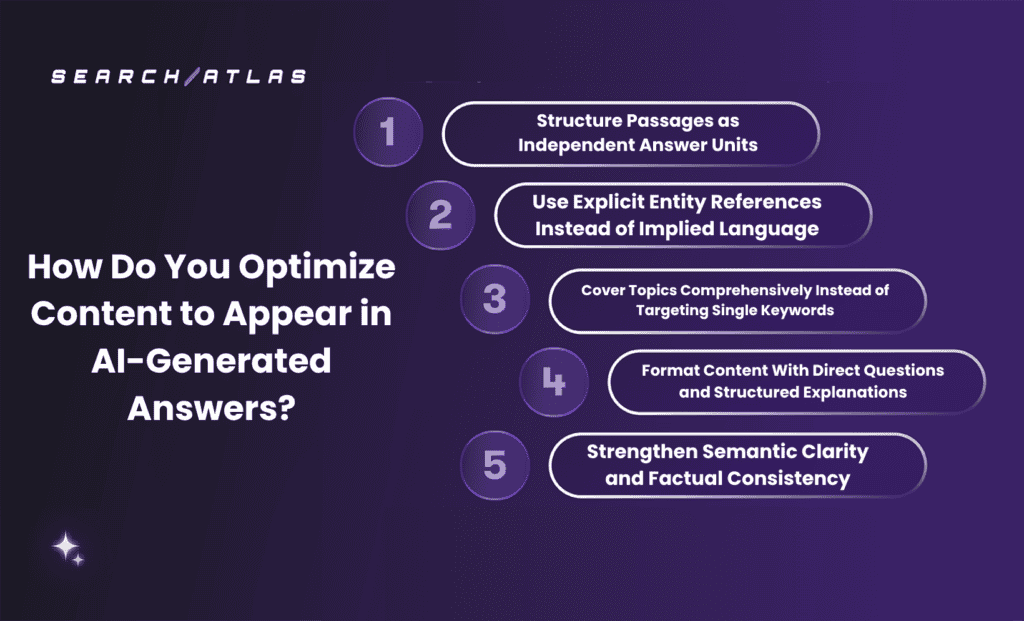
Optimizing content for AI-generated answers means structuring information that AI systems extract, interpret, and cite passages accurately inside generated responses. This process matters because AI search systems prioritize extractable explanations, explicit entities, and topical completeness when selecting sources for conversational answers. Strong AI answer optimization increases citation probability, improves semantic relevance, and strengthens visibility across AI-driven search environments.
The 5 ways to optimize content for AI-generated answers are listed below.
1. Structure Passages as Independent Answer Units
Independent answer units are paragraphs that explain a concept completely without relying on the surrounding context. This structure improves AI extraction because large language models retrieve isolated passages instead of entire documents. Businesses apply this structure by defining terms directly, explaining mechanisms clearly, and keeping each paragraph semantically complete. A practical rule is that every paragraph needs to make sense independently.
2. Use Explicit Entity References Instead of Implied Language
Explicit entity references mean naming concepts, brands, products, and processes directly instead of relying on pronouns or implied references. This practice improves AI retrieval because search systems organize information around entities and attributes. Businesses apply explicit entity references by repeating entity names naturally throughout explanations instead of replacing them with “it” or “they.” A practical takeaway is that AI systems extract attributed entities more reliably than implied references.
3. Cover Topics Comprehensively Instead of Targeting Single Keywords
Comprehensive topic coverage means addressing definitions, comparisons, mechanisms, subtopics, and related questions within the same subject area. This coverage improves AI citation probability because AI systems prefer sources that explain topics completely instead of partially. Businesses apply comprehensive coverage by building structured topical clusters instead of isolated keyword-focused pages. A practical rule is that broad topical depth creates more extraction opportunities than narrow keyword optimization.
4. Format Content With Direct Questions and Structured Explanations
Structured explanations mean organizing content with clear definitions, comparison sections, numbered processes, and direct question-answer formatting. This organization improves AI extraction because conversational systems identify reusable explanations more efficiently inside structured content. Businesses apply structured formatting by using descriptive headings and concise explanatory paragraphs. A practical takeaway is that AI systems extract structured answers more accurately than unstructured narratives.
5. Strengthen Semantic Clarity and Factual Consistency
Semantic clarity means presenting factual information with clear relationships between entities, attributes, and claims. This clarity improves AI trust because retrieval systems evaluate semantic consistency before generating answers. Businesses strengthen semantic clarity by validating facts, defining entities explicitly, and maintaining consistent terminology throughout the content. A practical rule is that factually consistent content earns stronger citation potential across AI-generated search systems.
What Content Structure Does AI Prefer When Extracting Answers?
AI extraction systems prefer content structures that present direct answers, explicit entities, and independently understandable passages. These structures matter because large language models retrieve isolated sections instead of reading documents sequentially from beginning to end. Strong extraction structures improve citation probability, answer accuracy, and AI visibility across conversational search systems.
The 7 main content structures AI systems prefer during answer extraction are listed below.
1. Starting sections with direct answers. AI systems favor passages that answer the question within the first one or two sentences. A paragraph beginning with a clear definition or explanation improves retrieval because the answer appears immediately. This structure increases extraction accuracy across AI-generated answers.
2. Using explicit entity names instead of pronouns. AI systems favor passages that repeat entity names clearly instead of relying on “it,” “they,” or implied references. Explicit entities improve attribution because retrieval systems organize information around named concepts and attributes. This clarity strengthens semantic interpretation during extraction.
3. Defining terms before expanding explanations. AI systems favor content that introduces and defines entities before discussing mechanisms or examples. Definitions improve retrieval because search systems identify entity meaning before processing supporting details. This structure increases answer reliability across extracted passages.
4. Structuring paragraphs as independent semantic units. AI systems favor paragraphs that make sense without surrounding context. A passage beginning with “as mentioned earlier” weakens extraction because the meaning depends on previous sections. Independent paragraphs improve citation reliability because retrieval systems extract isolated content blocks.
5. Using question-aligned headings and subheadings. AI systems favor headings that match common query structures and clearly label the following answer section. Question-based headings create additional retrieval entry points because search systems connect headings directly to user queries. This alignment improves featured snippet and AI Overview visibility.
6. Organizing information through structured sequences. AI systems favor numbered processes, comparison sections, and step-based explanations because structured formats improve extraction consistency. Structured sequences reduce ambiguity and make generated answers easier to synthesize accurately across conversational interfaces.
7. Maintaining semantic clarity across passages. AI systems favor passages with clear relationships between entities, attributes, and explanations. Semantic clarity improves retrieval because language models evaluate whether claims remain understandable outside the full document context. This clarity increases citation probability across AI-generated search environments.
These structures show that AI extraction depends on clarity, independence, and semantic organization instead of narrative flow alone. Strong AI-optimized content improves retrieval performance by making every section directly understandable, attributable, and reusable across generated answers.
How Do You Measure SEO Success When AI Overviews Reduce Click-Through Rates?
SEO success in AI Overview environments depends on visibility, citation presence, branded demand, and conversion quality instead of click-through rate alone. AI Overviews answer many informational queries directly inside search results, which means sites gain visibility and authority even when clicks decline. This shift changes SEO measurement from traffic volume alone toward broader visibility and influence signals across AI-driven search systems.
Click-through rate measures how often users click a result after seeing it in search. AI Overview visibility measures how often a brand appears in AI-generated answers and summaries. These definitions explain why clicks alone no longer reflect full SEO performance across modern search environments.
How does impression share measure SEO visibility in AI search environments? Impression share measures SEO visibility by tracking how often pages appear across search results, even when users do not click. AI Overviews satisfy many informational searches directly inside the SERP, which reduces clicks while visibility remains high. Tracking impression share alongside traffic reveals whether overall search exposure continues growing despite lower click-through rates.
How does branded search volume measure downstream SEO impact? Branded search volume measures downstream SEO impact by tracking how often users search for a brand directly after encountering it in AI-generated answers. AI citations and overview appearances increase familiarity and authority even without immediate clicks. This increase creates delayed demand that traditional click-based SEO models fail to capture.
How does AI citation tracking improve SEO measurement? AI citation tracking improves SEO measurement by monitoring how often brands appear inside conversational AI systems and generate search responses. Traditional rank tracking measures organic positions but ignores visibility across AI-generated answers. Citation tracking identifies whether brands appear inside platforms powered by large language models, which reveals visibility gaps that traditional rankings cannot show.
How does multi-surface SEO measurement improve visibility analysis? Multi-surface SEO measurement improves visibility analysis by combining traditional rankings, AI citations, impression share, and branded demand into one framework. Search visibility now exists across organic listings, AI Overviews, and conversational AI platforms simultaneously. This combined framework reflects how users increasingly discover and evaluate brands across AI-mediated search environments instead of traditional blue link results alone.
Is SEO Dead Because of AI?
No, SEO is not dead because of AI since businesses still need visibility when users search for products, services, and information. AI changes how search systems display answers and evaluate visibility, but AI does not remove the need for content strategy, technical optimization, or search presence.
SEO is not dead because of AI, because AI search still depends on websites, entities, and structured information as source material. AI systems retrieve, summarize, and cite content from indexed pages when generating answers. This retrieval keeps SEO relevant because brands still compete for visibility, citations, and authority inside AI-driven search environments.
SEO is not dead because search behavior still revolves around intent matching and information retrieval. Users continue asking questions, comparing solutions, and searching for products across search platforms. This behavior preserves the need for optimized content, semantic structure, and topical authority even as search interfaces evolve.
SEO is not dead because only outdated optimization methods lose effectiveness. Strategies built entirely around keyword stuffing, isolated pages, and low-value content lose visibility as AI systems evaluate semantic depth and answer quality. This shift changes SEO methodology without eliminating the discipline itself.
Will AI Replace SEO Professionals?
No, AI will not replace SEO professionals because SEO still requires strategic judgment, competitive analysis, and decision-making beyond automated execution. AI changes how SEO work gets completed, but AI does not replace the need for humans to define goals, evaluate priorities, and control quality across search strategies.
AI will replace SEO professionals in repetitive and rule-based execution tasks. AI systems automate metadata generation, schema deployment, internal linking, crawl error detection, and reporting workflows at large scale. This automation increases operational speed because machines execute structured optimization tasks continuously across large websites.
AI will not replace SEO professionals in strategic planning and business-level decision-making. Search strategies still depend on understanding competitive positioning, audience behavior, brand differentiation, and commercial priorities. These decisions require contextual judgment that AI systems optimize around but do not define independently.
AI will not replace SEO professionals because automation still requires configuration, oversight, and quality control. LLMs generate inaccurate recommendations, weak content structures, and low-value optimization patterns without human review. This limitation increases the importance of professionals who validate outputs and guide automation systems effectively.
AI changes the role of SEO professionals from manual execution toward strategy and oversight. SEO specialists increasingly operate as decision makers who define objectives, evaluate AI outputs, and manage optimization systems instead of performing repetitive technical tasks manually. This shift concentrates SEO expertise in the strategic layer that determines what automated systems optimize and why.
Can AI Answers Fully Replace Organic Search Results?
No, AI answers cannot fully replace organic search results because many searches still require comparison, verification, current information, and direct source evaluation. AI answers satisfy simple informational queries effectively, but organic results remain necessary for commercial decisions, specialized research, and high-trust searches.
AI answers replace organic search results most effectively for factual and stable informational queries. Users searching for definitions, short explanations, or basic facts often receive complete answers directly inside AI-generated responses. This behavior reduces clicks because search intent becomes satisfied before users open external websites.
AI answers cannot fully replace organic search results for queries requiring current, competitive, or proprietary information. Commercial searches often require users to compare products, evaluate multiple sources, and verify claims independently. This requirement keeps organic search relevant because users still need direct access to websites, reviews, pricing, and primary information sources.
AI answers cannot fully replace organic search results because trust and verification remain important across high-stakes searches. Users frequently consult primary sources when evaluating financial, medical, legal, or technical information. This behavior preserves the value of organic listings because users seek transparency, detail, and source-level credibility beyond summarized AI outputs.
AI answers change search behavior by adding a new visibility layer instead of eliminating traditional search systems. AI-generated answers, featured snippets, knowledge panels, and organic listings now operate together across modern SERPs. This expansion changes how brands earn visibility because search exposure increasingly depends on both organic rankings and AI-generated citations simultaneously.
What Happens to Brand Visibility Without an AI SEO Strategy?
Brand visibility declines across AI search environments when companies rely only on traditional SEO without adapting to AI-generated answer systems. This decline matters because AI Overviews and large language models increasingly function as the primary visibility layer for informational queries.
Brands without an AI SEO strategy lose visibility inside AI-generated answers even when pages rank well organically. AI systems do not automatically cite high-ranking pages because citation selection depends on extractable structure, entity clarity, semantic coverage, and external authority signals. This difference creates visibility gaps between traditional rankings and AI-generated search exposure.
Brands without an AI SEO strategy lose associative authority across conversational search platforms. Users repeatedly encountering competitor brands inside AI-generated answers begin associating those brands with expertise and trustworthiness. This repetition strengthens competitor authority while invisible brands lose recognition across informational search journeys.
Brands without an AI SEO strategy lose measurement accuracy across modern search environments. Traditional rank tracking reports show keyword positions but fail to measure visibility inside AI Overviews and conversational AI platforms. This limitation hides citation gaps because brands appear successful in organic rankings while remaining absent from AI-generated responses.
Brands without an AI SEO strategy reduce long-term competitive visibility across evolving search systems. Traditional SEO signals (topical authority, semantic structure, and technical optimization) still matter, but AI search introduces additional extraction and citation requirements.
Businesses maintaining visibility across both traditional SERPs and AI-generated answers adapt existing SEO workflows to account for AI-driven search surfaces instead of treating them as separate ecosystems.